
Individual Research projects

Individual Research Projects and Doctoral Candidates Presentation
Eighteen Individual Research Projects (IRPs) were designed to attain the specific research objectives of ESM.
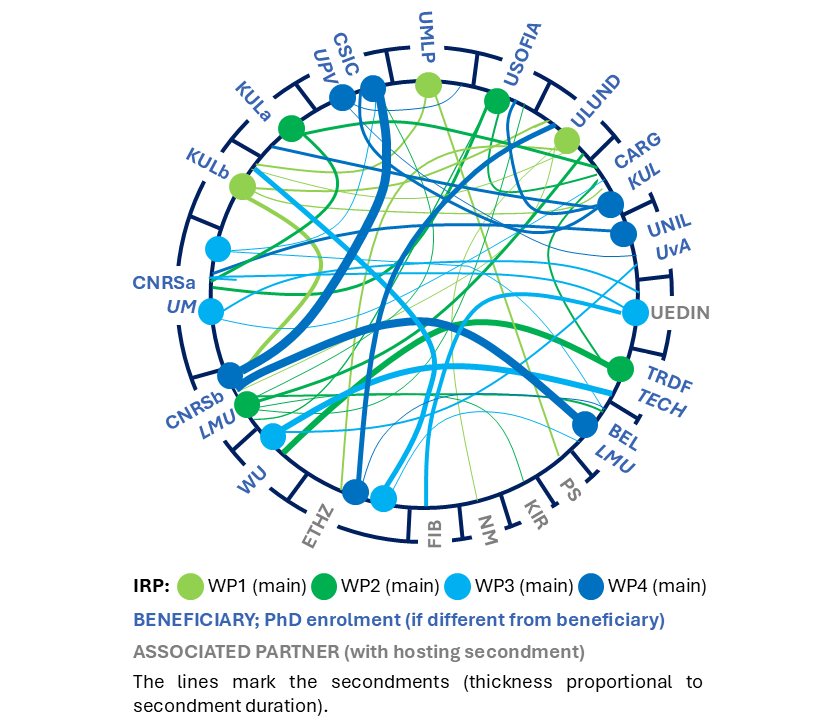
Collaborative
aspects of the
IRPs
IRP1 : Additive fermentation in legume protein extraction: Impact on the macromolecular profiles and functional properties
Eghnatios EL ALAM
My name is Eghnatios AL ALAM, and I am an Agri-Food Engineer from Saint-Joseph University of Beirut. During my final year of engineering, I completed an exchange semester at Institut Agro Rennes–Angers, where I specialised in Research and Development (Master 2). I joined the ESM programme driven by a strong interest in research and by the ambition to help build a more sustainable food future.
In my PhD, I study natural bacteria (lactic acid bacteria) that can produce useful substances such as exopolysaccharides during fermentation. By growing them on plant-based ingredients like pea protein powder, I aim to improve the texture and quality of foods made from plant proteins. This research could help create healthier and more sustainable products for the food industry and, ultimately, for consumers by replacing artificial food texturisers with natural, plant-based alternatives.
Outside of my work, I enjoy watching and reading content related to science, world cultures, culinary traditions, and travel interests that continually inspire my curiosity and creativity. I am excited to be part of the ESM community and to contribute to this innovative project.
IRP2 : Novel formulation strategies by revealing the supra-molecular structure of plant-based protein-lipid assemblies
 Matas Martisauskas
I hold a Master’s degree in Chemistry from the University of Edinburgh, where I first became interested in the chemistry behind foods and beverages. During my master’s thesis year at Unilever Colworth R&D, I was introduced to edible soft matter and developed a lasting curiosity about food structuring. After graduation, I joined Unilever, working on applied food innovation and seeing how scientific research can improve nutrition and resilience across global food systems.
Recognizing the need for deeper academic research in this area, I joined the ESM project at Lund University. My research focuses on the shift from animal to plant proteins in food formulation. While this transition is essential for sustainability, plant proteins often show poor functional properties, particularly in gelling, emulsifying, and foaming. These differences influence texture and mouthfeel, making it challenging to replicate the sensory qualities of animal-based foods.
In my project, I study how different plant-derived components like proteins and polar lipids, interact to create new structures that can bridge the functionality gap with their animal-based counterparts. To do this, I observe how these structures form and behave at the microscopic level. This deeper understanding will help in designing better plant-based foods that are both nutritious and enjoyable to eat, supporting a more sustainable food future.
IRP4 : Structured and functional emulsions and foams
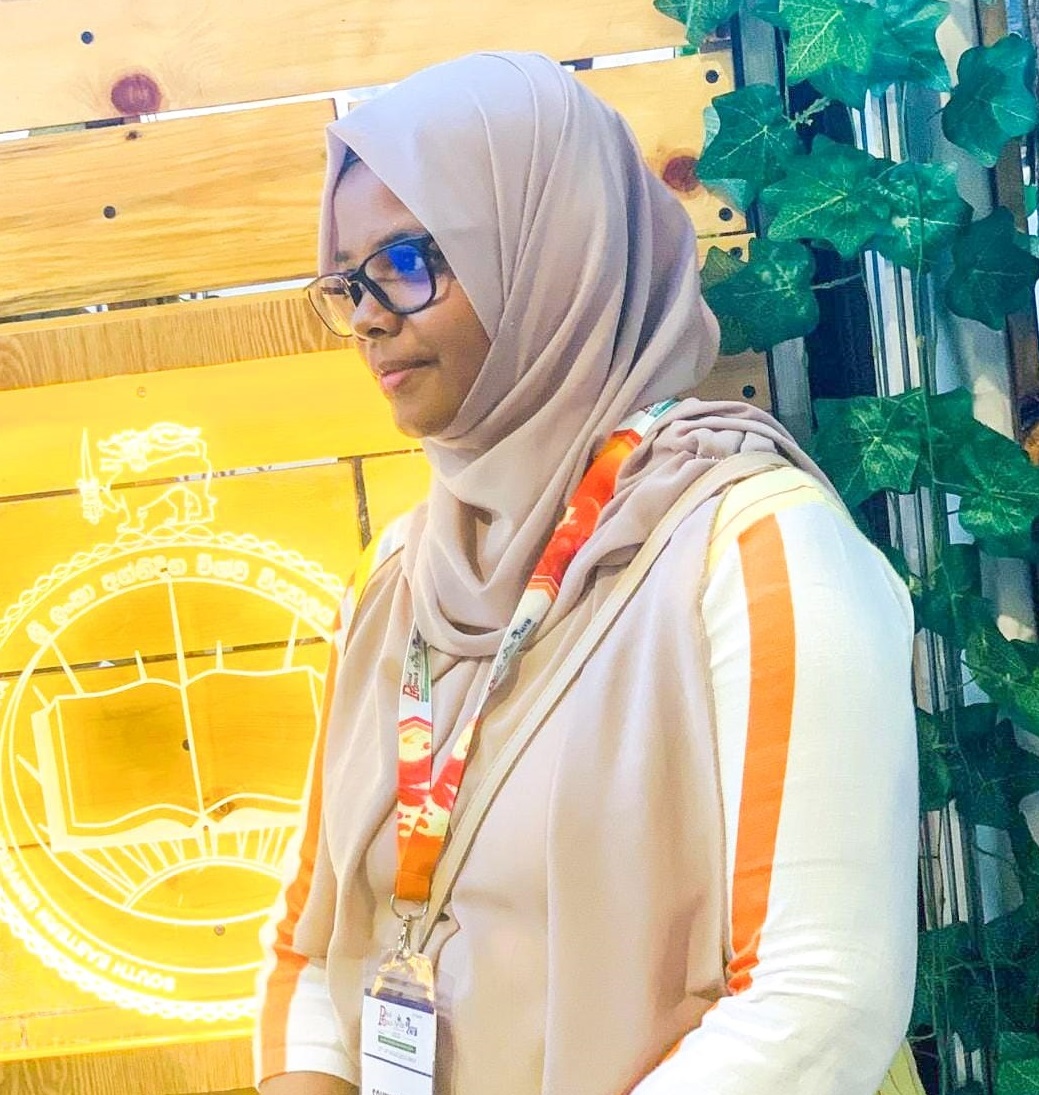 Fathima Jemziya
My name is Fathima Jemziya, and I am from Sri Lanka. I hold a master’s degree in Food Science and Technology. As a university academic and researcher, I have developed a strong interest in food structure, functional ingredients, and dietary solutions developed for vulnerable populations.
My scientific interests lie at the intersection of food materials, nutrition, and innovative processing technologies. These motivations led me to pursue a PhD that connects material behaviour with real-world health and sustainability challenges. Joining the Edible Soft Matter MSCA Doctoral Network is a natural step for me, as the programme aligns closely with my commitment to advancing sustainable food innovation.
My PhD research deals with the development of new efficient approaches for the structuring of low-fat and low-calorie food emulsions and foams using natural and functional ingredients obtained from sustainable plant sources.
Through the MSCA Doctoral Network, I am particularly motivated by the opportunity to work across diverse European research environments and gain hands-on industrial experience, thereby enhancing the translational impact of my research.
IRP5 : Edible Water in Water Emulsions
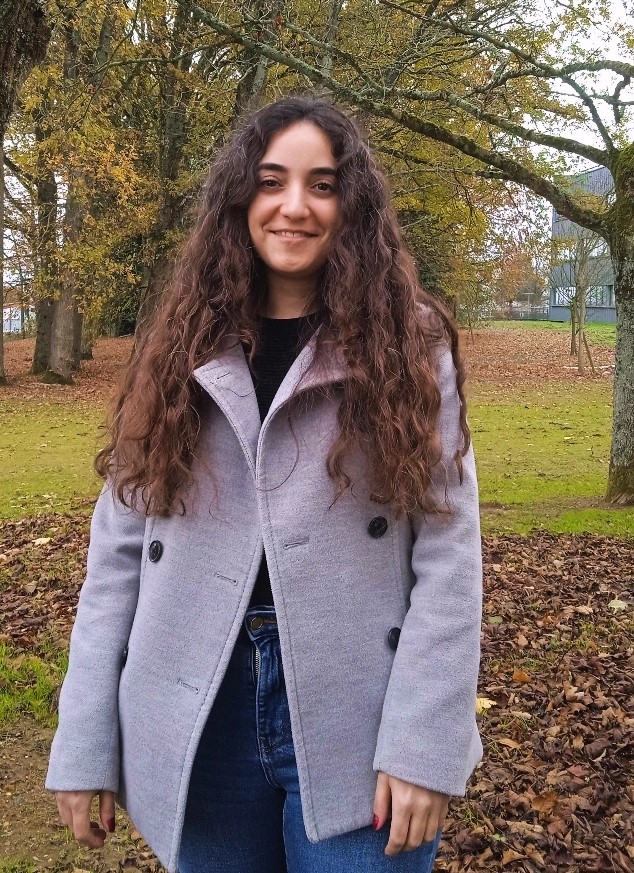 Mehtap Keklik
Hello! I’m Mehtap from Turkey, and I hold a Master’s degree in Food Engineering. My passion for healthy and functional foods has grown over time, and I am especially interested in plant-based projects as a vegetarian. I have also focused on emulsion gels, which sparked my curiosity and creativity in designing innovative food structures. Before joining the ESM programme, I worked on projects studying how proteins behave during digestion and how we can use them to make healthier and more innovative food products.
In the ESM programme, I’m diving into the world of edible water-in-water emulsions. The aim is to create stable, natural structures that can carry healthy ingredients—just like traditional emulsions in many foods, but completely oil-free! This project lets me combine my past experience with exciting new techniques and collaborate with amazing experts from different countries.
In my free time, I love practicing pilates, going on hikes, exploring nature, traveling to discover new places, and exploring different vegetarian foods.
IRP6 : Relating the colloidal and air-water interfacial properties of plant protein systems

Agathe Tanchoux
Hello! I’m Agathe, a 24-year-old food science engineer coming from Versailles next to Paris. I completed my Master’s degree in Food Product Development at AgroParisTech in France and I graduated in 2025. I want to be part of the food transition by working on plant-based proteins. I am interested in understanding the underlying mechanisms between food components that make food so delicious. This is the reason why I have joined ESM. On a personal side, I love baking and cooking. I enjoy spending time outside in nature sometimes by hiking but mostly by running.
My PhD project aims to relate colloidal and air/water interfacial properties of oat protein systems, in other words to understand how oat proteins stabilise an air bubble. To do so, various chemical, physical and enzymatic processing steps on the isolation of plant proteins will be investigated as well as their effects on foaming properties. On the long term, this project will provide valuable insights to the food industry for developing plant-based alternatives that offer similar functionalities to those of animal products.
IRP7 : Structuration of plant proteins with polysaccharides
 Federica Pinci
My name is Federica, I am 26 years old and I come from Italy. I have a Bachelor degree in physics and a master degree in condensed matter physics, both obtained in Perugia – a small, but lovely city in the center of Italy, not far from my hometown. I am a sociable and curious person, I enjoy seeing new places and meeting people, but I also love quieter situations with my friends. I really enjoy going to the sea, going to flea markets or just wandering around in my city.
Although studying in Perugia was a fantastic experience, both academically and personally, for my PhD I felt the need to try a new environment and experience the international climate that characterises scientific research. Furthermore, during my master’s degree, I developed a passion for soft matter and realised that I would like to continue in the field of applied physics, even – why not – on an interdisciplinary topic.
This reasons led me to the Edible Soft Matter Network. My project is focused on putting the basis for developing a valid plant-based alternative to gluten, and will mostly take place at the laboratory L2C, in Montpellier. The strategy will be to combine the properties of two classes of natural polymers, proteins and polysacharides, in order to design a gel which mechanical properties resemble the ones of gluten. Sensory tests on the prototype material will be performed in collaboration with the IATA institute in Valencia.
I am very excited to join this Doctoral Network, and to improve my knowledge and bride my horizons with this project!!
IRP8 : Tribological properties of dispersed and multi-component food systems
 Foteini Giannakaki
I am Foteini Giannakaki and I come from Greece. I am a food scientist and I hold an Integrated Master’s in Agriculture – Food science and technology, and a Master’s in Food science and nutrition, both from School of Agriculture of Aristotle University of Thessaloniki. In my free time, I enjoy walking and hiking. Staying connected with nature helps me feel calm and improves my creativity and well-being. I also enjoy spending time with friends.
During my master’s degree I worked on multicomponent gels (hydrogels, oleogels and hybrid gels) that could even be used in vegan foods as fat replacers. Through this work I became fascinated by how structure can influence the properties and texture of foods and by the importance of such research considering the growing demand for health-promoting and environmentally sustainable food products.
The curiosity led me to ESM project. Within this interdisciplinary project I will have the opportunity to deepen my understanding of soft matter and food structure especially in plant-based systems. Under the supervision of prof. Elke Scholten, in Wageningen University, we will investigate the relationship between the structure and the lubrication behavior of multi-component systems, with a focus on oleo-based systems.
I am grateful and excited to be part of ESM project and look forward to learning, collaborating and contributing to this inspiring interdisciplinary community.
IRP9 : Physical properties of cellulose suspensions for food applications
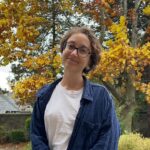
Caterina Cocca
Hi! I’m Caterina, from Naples, a sunny city in southern Italy.
My studies brought me far from home—I have a bachelor’s in Physical Engineering from Politecnico di Torino (northern Italy) and a double master’s degree in Physics of Complex Systems from both Politecnico di Torino and Université Paris-Saclay (Paris, France).
What led me to join this Edible Soft Matter network?
My passion for physics combined with my obsession for cooking and baking!
Whenever I have free time, I’m experimenting with new recipes for bread, sweets, and pizza (a taste of home). I’m quite hyperactive and curious, always exploring new places and cultures through travels. But I also have a calmer side—loving movies, books, crocheting, caring for my
plants, and spending time with fluffy pets at home.
My project investigates how cellulose—Earth’s most abundant biopolymer—can be optimized for food applications. Working with microfibrillated cellulose from FiberLean (Cornwall, UK) at the University of Edinburgh’s Soft Matter group, my project will research some fundamental questions: How do variations in cellulose morphology and surface chemistry affect its behaviour in complex food matrices? Are we truly optimising its performance in food products?
Collaboration with the University of Montpellier will enable investigation of cellulose-protein mixtures to reveal how cellulose behaves in more realistic food-like environments( e.g. bread dough), providing insights to deploy cellulose as a sustainable and health-promoting ingredient
in foods.
I’m excited to be part of this network and contribute to building a more resilient future, bringing all my curiosity and energy to drive this change!
IRP10 : Characterisation and modelling of the unique non-linear rheology of gluten
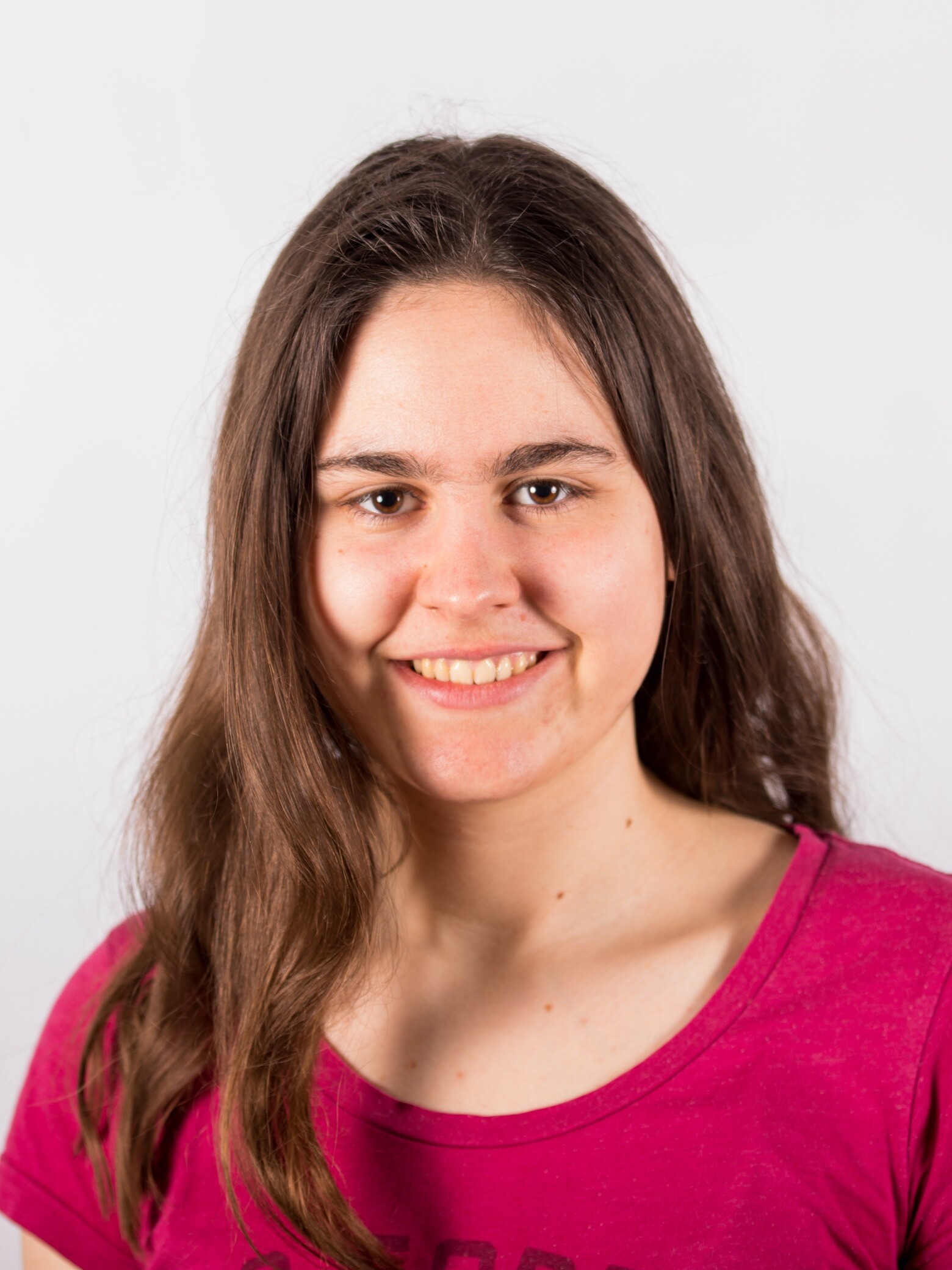
Hester van Wachem
Hi! My name is Hester. I completed both my bachelor and master degrees in Applied Physics at the University of Twente in the Netherlands. Throughout my studies, I really enjoyed projects that connect different field of science. For example, I worked with a chemistry group on polymer coatings. For my internship, I joined a biophysics group where I looked at cells, and for my master’s research at the physics of fluids group.
During my PhD, I will be looking at the structure of gluten and how it behaves when stretched or mixed. Gluten has many interesting structural properties, and my goal is to understand these in order to find gluten-free alternatives.
Outside of academia, I enjoy running, hiking and travelling.
IRP11 : Structure, stability, and mechanical properties of complex hybrid plant protein-polysaccharide gels
 Siham El Aani
I graduated in 2023 from Sorbonne University with an MSc in Material Chemistry, where I focused on the physico-chemistry of polymers in solution, structure–property relationships in macromolecular systems, and the characterization of soft and dynamic materials.
Driven by curiosity and a desire to connect science with real-world applications, I also trained in software design and development in 2024. During this time, I worked on digital projects related to sustainable food systems, including a platform aimed at increasing visibility for local farmers and promoting short food supply chains (AMAPs), as well as a recipe generator designed to reduce food waste by helping people create meals from ingredients they already have. These experiences broadened my perspective on sustainability challenges across the food chain.
Beyond research, I’m passionate about science communication, making innovation accessible, and exploring how materials science can contribute to everyday life. I’m also interested in sports and nutrition, which naturally connect with my belief that access to good, sustainable
food is essential for well-being.
Joining the Edible Soft Matter MSCA Doctoral Network was a natural step for me. The ESM programme perfectly bridges my passion for materials science with real-world applications in sustainable food. My PhD project at Unilever focuses on understanding and designing complex hybrid plant protein–polysaccharide gels that incorporate a dispersed lipid phase. These systems serve as model emulsions for food products. By understanding how microstructure governs emulsion stability and mechanical performance, this work aims to support the development of more appealing and sustainable food products.
IRP12 : Reversibility of plant-based dispersions and emulsions structure and functionality upon drying/redispersion

Roxane Grard
I’m Roxane, and I graduated as a Chemical Engineer specialized in Formulation from the École Nationale Supérieure de Chimie de Lille.
During my six-month Master’s internship at AgroParisTech, I discovered the world of research focused on the future of food and the many challenges it presents. This experience motivated me to apply the physico-chemical skills I developed during my studies to projects aimed at creating sustainable ingredients and food products.
My research focuses on studying the reversibility of drying and rehydration processes in plant protein emulsions. I aim to understand how the microstructure of the emulsion influences the drying process and the properties of the resulting powder. A multiscale characterization of the system will be carried out, considering all the parameters that can be adjusted during processing and formulation. This project seeks to provide a fundamental understanding of the mechanisms involved in drying and redispersing emulsions.
Outside of my research, I’m always up for trying new sports like running, cycling, and bouldering. I have to admit, running is my personal favorite, though we’ll see if that stays true after I tackle my upcoming half-marathon! As for cycling, it’s my go-to way to explore the landscapes of Belgium (and who knows, maybe one day I’ll cycle around the world!).
IRP13 : Structural approaches for improving sensory and satiety of vegetables spreads analogues
 Laura Rivera Paternina
I’m Laura Rivera Paternina from Barranquilla, Colombia, a Food Engineer with a master’s degree in Engineering and Food Science. I’ve been working as an R&D specialist in the food industry, developing nutritious and appealing products that blend science and creativity. Passionate about food innovation, I’m always exploring new ways to enhance flavour, texture, and nutritional value. I also enjoy spending time in nature, hiking, traveling, and volunteering to care for stray animals.
Within the ESM Program, I am deepening my expertise in plant-based ingredients and collaborating with multidisciplinary teams to design more sustainable food solutions. My current PhD research focuses on developing strategies to improve sensory and satiety of plant based analogues. This work aligns with my mission to develop nutritious, sustainable and appealing food products that meet real-life needs.
IRP14 : Improve design of plant based ‘cheese’: impact of formulation and environmental conditions on the mechanical properties
 Sarah Sessa
I’m from Naples, Italy. I hold a Master’s degree in Product Chemical Engineering with a strong interest the microscopic interactions among molecules and particles that define the macroscopic properties of soft matter.
Passionate about food research and consumer-driven innovation, outside the lab I love cooking and discovering new cultures through food, languages, and meeting people who share the same curiosity for science and creativity.
I am thrilled to join the ESM Network in collaboration with Groupe Bel and Le Mans Université with a PhD project focused on understanding how formulation and environmental conditions influence the structure and mechanical behavior of plant-based cheese alternatives.
By combining my scientific background with my passion for food, this project is a unique opportunity to embrace the challenge of developing real, impactful products that meet both consumer needs and sustainability goals.
IRP15 : The role of plant-based proteins on the structure and quality of plant-based cheese
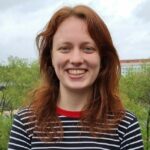 Marit Schaap
My name is Marit and I am from the Netherlands. I followed my BSc and MSc Food Technology at Wageningen University and Research, where I specialized in product design and ingredient functionality.
Over the course of my studies, I developed a strong interest in the design of healthier and more sustainable plant-based foods. Plant-based meat and dairy analogues offer a challenge in obtaining a satisfactory sensory and textural experience similar to the animal-based product. This can be achieved by relating the physico-chemical aspects of a food to its functionality, which I further explored during my thesis and internship. This focus aligns with the objectives of the ESM project to obtain an understanding of the structure-function relationships of plant-based foods to ultimately develop novel food products. Within that falls my PhD project on plant-based cheese, for which I will investigate the link between the micro- and macrostructure and the quality of plant-based cheeses. The role of each ingredient, with a focus on plant-based proteins, and their interactions with each other will be investigated. This will be done through applying a variety of techniques to analyze microstructure, textural and sensory characteristics of the developed plant-based cheeses.
The goal of this project is to obtain a better understanding of how ingredients interact to tune the properties of plant-based cheese and ultimately contribute to nutritional and sustainable novel plant-based cheese analogues.
IRP16 : Design of meat analogues with in-situ neutron and x-ray scattering techniques
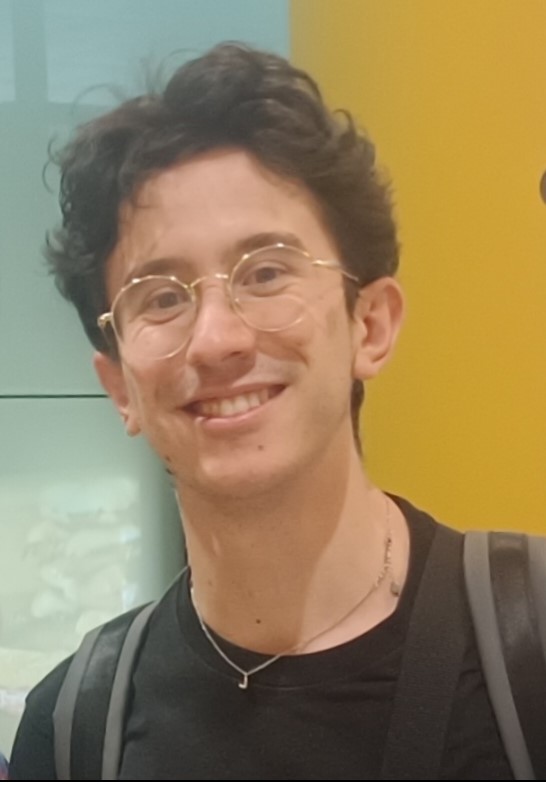 Josep Maria De Dios Pont
My name is Josep Maria (or Txema), and I am a food scientist from Barcelona. I graduated in Food
Science and Technology from the Universitat Autònoma de Barcelona and later completed the
Erasmus Mundus Master’s in Sustainable Food Systems, Engineering, Technology and Business,
studying across KU Leuven, Universidade Católica Portuguesa, Anhalt University of Applied
Sciences, and University College Dublin.
My main scientific interests are alternative proteins, food structure and food sustainability. I am
especially passionate about the production of meat analogues, and understanding how plant-based
ingredients can be transformed into meat-like products that are more sustainable while still being
nutritious, functional, enjoyable and having similar fibrous structures. This interest naturally led me to
this PhD project, where I focus on the design of plant-based meat analogues, trying to better
understand how processing conditions, formulation, and material behaviour can be controlled to
achieve improved texture, structure, and overall product quality.
For this reason, I am very grateful for the opportunity to study a field I am truly passionate about
while working with people who share similar interests.
IRP17 : Proteins in a pressure vessel: Exploiting the pressure-temperature-flow process window
 Duolima Han
Hello! I am Duolima Han from Inner Mongolia, China. I completed my Master’s degree in Food Science and Technology at the University of Copenhagen. I am very interested in the development of innovative and sustainable foods, especially in understanding the structuring mechanisms of plant proteins. This is why I felt particularly drawn to the ESM project and its ambition.
My PhD project focuses on investigating the structuring mechanisms of plant proteins under pressure. More specifically, I aim to understand how protein–protein interactions and interactions between proteins and other matrix components contribute to the formation and stability of food structures during and after pressure-assisted processing. Through this work, I hope to contribute to the development of plant-based food materials and advanced processing strategies.
Beyond academia, I enjoy traveling and exploring different cultures. These experiences allow me to broaden my perspective, stay curious, and appreciate the diversity of the world.
I am truly happy to join the ESM Doctoral Network. I look forward to learning and growing together with others who share the same passion for promoting the transition towards plant-based food.
IRP18 : Plant-based hydrogels and emulgels: Impact of correlation length on sensory perception
 Karina Cruz Tenjhay
I am Karina Cruz Tenjhay, from Mexico. I hold a BSc in Food Engineering and an MSc in Sustainable Food Systems Engineering from KU Leuven. My academic and professional background has focused on food quality, packaging, and valorization of by-products through sustainable processes.
My curiosity about the physical structure of foods and its impact on sensory experience led me to the field of edible soft matter. Within the Edible Soft Matter (ESM) programme, my PhD project (IRP18) focuses on Plant-based hydrogels and emulgels: Impact of correlation length on sensory perception. The goal is to understand how the microstructural properties of edible gels and emulsions influence their sensory behavior, ultimately contributing to the development of novel, plant-based soft materials with desirable textural and sensory characteristics
Beyond science, I enjoy exploring art, languages, and cultural diversity. I am passionate about traveling and discovering local traditions through food and music. I also love reading, cooking, and art-house cinema, as well as spending time outdoors; especially hiking and being in the mountains, where I feel most connected to nature.